When a part must meet the most demanding hazard level of the European railway fire standard, phenolic resin chemistry starts with an advantage. And with compression moulding, that part can be three-dimensional, with ribs and bosses — it does not have to be a flat panel.
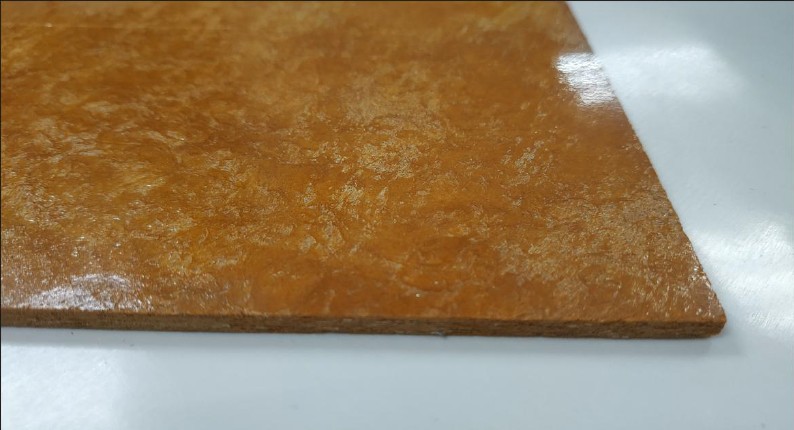
Phenolic resin tends to char rather than melt or drip, and produces little smoke: its good fire performance does not rely only on added flame-retardant fillers, but on the matrix itself.
Our phenolic SMC meets the applicable EN 45545-2 requirements at HL3 for the certified configuration — the level required for vehicles with the most demanding evacuation conditions.
Linings, covers, housings and three-dimensional parts moulded in one go, with thicknesses and ribs tuned to the stiffness you need.
CNC machining and 5-axis waterjet cutting in-house for holes, trims and dimensional fit, with no third parties involved.
The standard does not "certify" a material in absolute terms: it classifies it against a requirement (R), which depends on the location and function of the part (for example R1 for interior linings or R6 for seats), and a hazard level (HL1–HL3), which depends on the vehicle’s operation and design category.
The tests measure flame spread (ISO 5658-2), heat release (ISO 5660-1), smoke density (ISO 5659-2) and gas toxicity (Annex C of the standard). That is why, for each part, we confirm with the customer the requirement and level their specification calls for.
| Characteristic | Phenolic SMC |
|---|---|
| Process | Compression moulding, glass-fibre-reinforced phenolic resin |
| Fire standard | EN 45545-2 — HL3 hazard level (certified configuration) |
| Requirement (R) | Depends on the application — tell us where the part goes and we will confirm the applicable classification |
| Typical application | Linings and interiors for rolling stock |
| Finishing | CNC machining · 5-axis waterjet cutting |
Need EN 45545-2 with higher volumes or lower cost? We also work with flame-retardant polyester SMC classified R1, R2, R3, R6, R7 and R17 up to HL3.
Flame-retardant polyester reaches its fire classification thanks to fillers such as aluminium trihydroxide; in phenolic SMC, fire behaviour comes from the resin itself. Depending on the grade, both can reach HL3 under EN 45545-2: we choose one or the other based on the requirement, weight, volume and cost of the part.
It is set by EN 45545-1 from the vehicle’s operation and design category, and is usually fixed in the train manufacturer’s specification. Tell us the level and requirement and we will propose the material.
Yes: in-house engineering with CAD/CAM (SolidWorks, CamWorks) and 3D printing for prototypes, working with the customer’s engineering team from the concept phase.
Tell us about the part, its location in the vehicle and the required hazard level: we will propose the material and confirm feasibility.