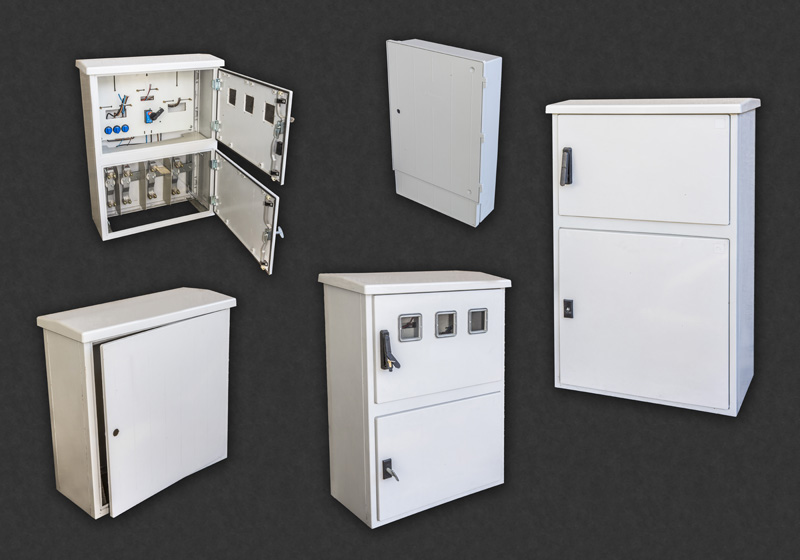
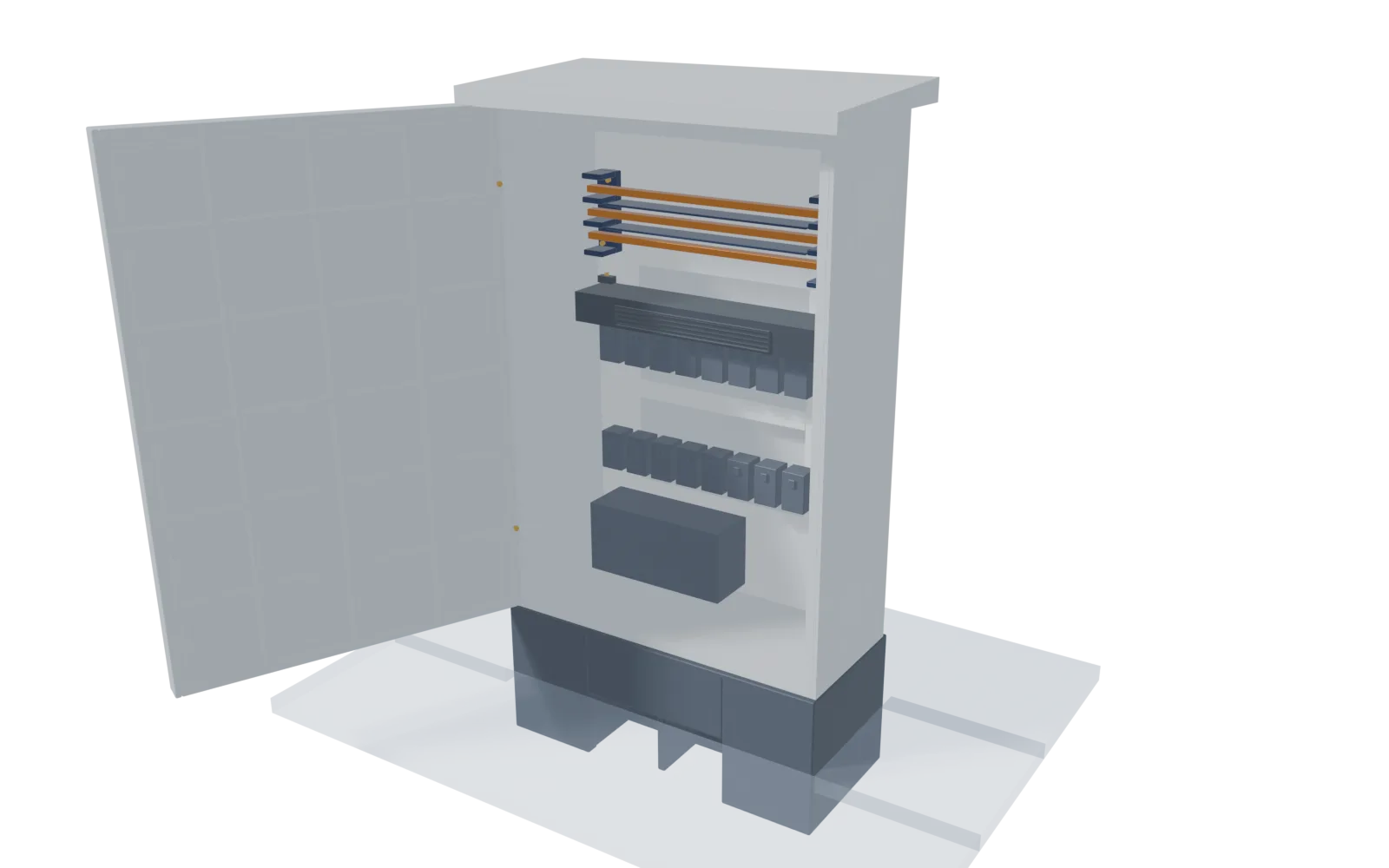
One-piece enclosure
- Location
- Enclosure body and rain canopy.
- Recommended material
- Electrical SMC V-0 / CTI 600
- Requirement / key data
- UL 94 V-0 @ 3 mm · CTI 600 · 16 kV/mm · HDT > 250 °C
1Part detail and process
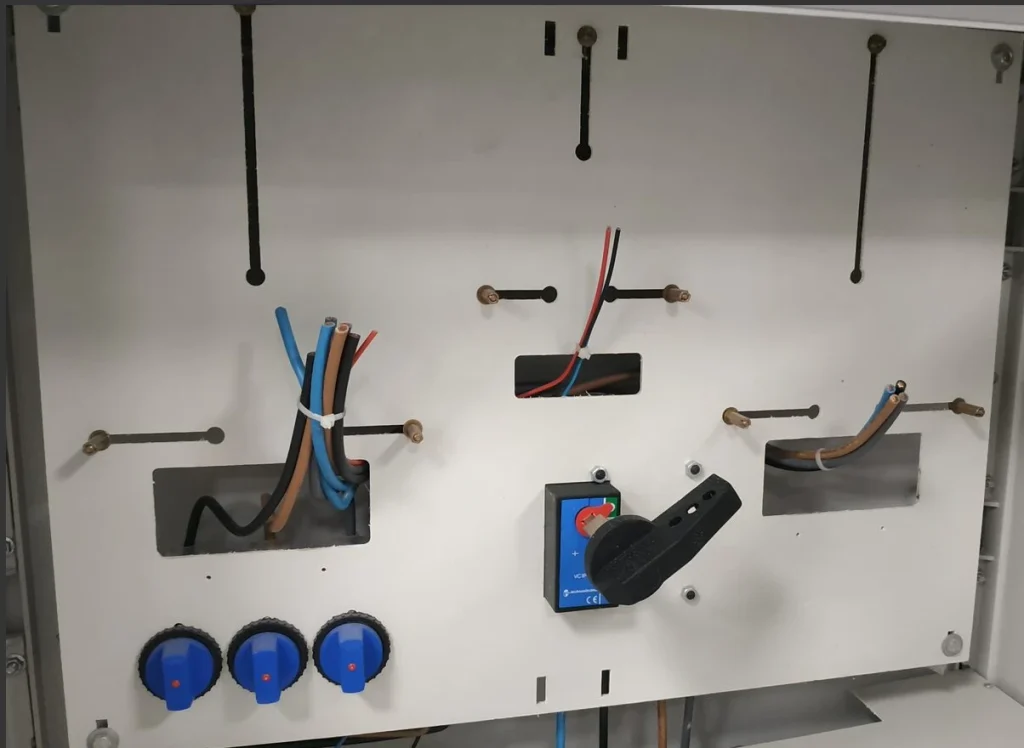
One-piece body with external rib grid, drip-edged rain canopy, side grilles and bosses with overmoulded brass inserts for the plate. Typical thickness of 2.5 to 6 mm for moulded parts. 5-axis waterjet trimming (0°–64°) and in-house CNC machining. Finish: technical visible face in the material colour.
2Assembly and fixing to the structure
- M5–M12 threaded metal inserts, moulded in or installed cold or hot into reinforced bosses.
- Perimeter lip or channel for a sealing elastomer gasket.
3Lightweighting: ribbed monolithic or sandwich
Proposed solution: ribbed monolithic. Thin wall with 3D ribs, bosses and inserts where the loads arrive — right for compact parts or point loads. For large spans, a sandwich panel is assessed.
4Advantages over the traditional alternative
Compared with cut, welded and painted steel sheet — Electrical SMC V-0 / CTI 600: 16 kV/mm, CTI 600, glow wire 960 °C, HDT > 250 °C, dielectric constant 4 and UL 94 V-0 at 3 mm. Corrosion-free, weld-free and inherently insulating.
5Series and manufacturing capacity
Typical series (indicative): 500 to 20,000+ pcs/year, typical of electrical enclosures and automotive. Press: P10 (1,250 t, 3,500 × 1,800 mm platen) or P8 (10,000 kN, 2,800 × 1,800 mm). In-house fleet of 7 presses from 150 to 1,250 t, with a largest platen of 3,500 × 1,800 mm. The steel mould is amortised over the series: the higher the volume, the lower the tooling cost per part; for short runs we compare with other solutions.